
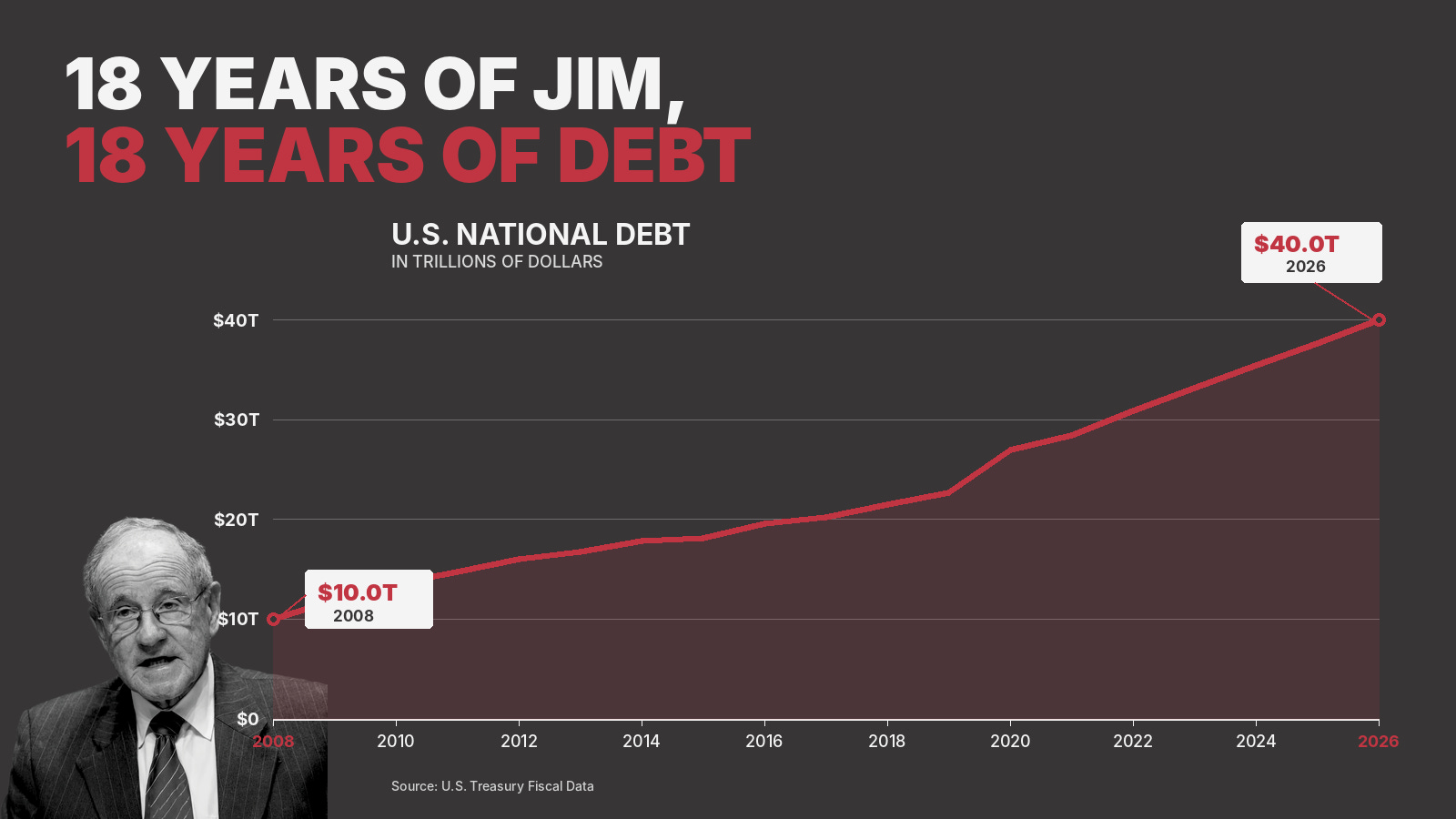
You may be assuming that I am writing about the national debt hitting $40 trillion. You may even be expecting me to emphasize that the debt has quadrupled since Risch first took office and point out that just last year Jim voted for the Big Beautiful Bill, increasing the deficit by another $3.4 trillion that we do not have. And while these issues are all incredibly important, every media outlet has and will continue to cover them in depth. Instead of rehashing how we got here, I want to focus on recent Treasury Department moves that reveal just how precarious our debt problem has become and the increasingly drastic measures needed to retain some semblance of fiscal stability. That is, we are now seeing the real world impacts. We have reached the point where we can no longer kick the can down the road. The two-party system has failed this country and we need independents to get this country back on track.
Saving the Yen
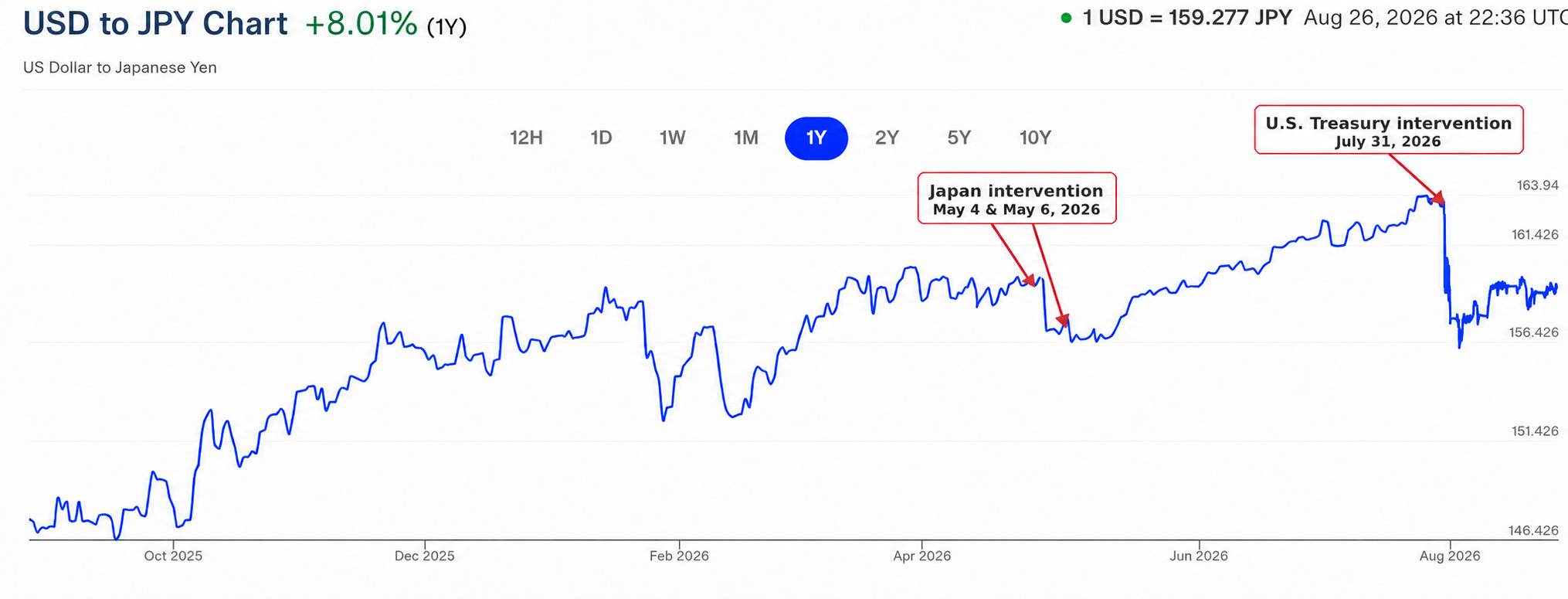
Last month the world took notice when the US took the unusual move to prop up the Japanese Yen. I want to emphasize how rare this action was; the Treasury has only directly intervened in foreign exchange markets three times since 2000. To save the Euro in the year after its initial introduction, weaken the yen after the Fukushima earthquake and prevent a currency crisis from derailing Argentina’s sweeping economic reform program.
With these precedents, it makes you wonder what short-term emergency Japan is facing to justify this drastic action. The short answer is it’s not. Instead the US was forced to intervene because of its own debt crisis. What could a foreign currency’s exchange rate have to do with US debt? The immense size of our fiscal burden means we must rely on buyers with enough money to purchase large amounts of our debt, and foreign governments are among the few able to do so. Japan is the largest foreign holder of U.S. government debt, owning roughly $1.1 trillion in Treasury bonds. That’s why propping up the yen became a threat to our own fiscal stability, and why we stepped in. Japan had already sold about $162 billion in US Treasury bonds in May without much effect, and looked set to fund August the same way.
This matters to every American because a rapid sale of U.S. government debt would increase the amount of bonds on the market, making newly-issued debt harder to sell. To attract buyers, the U.S. government would have to offer higher interest rates, thus making borrowing more expensive. Since the government continues to issue debt at an ever-increasing pace, it is increasingly saturating the market - trying to sell more debt to similar – or shrinking – numbers of buyers and having to take whatever price the market offers. The effects would then spread through the economy, raising borrowing costs for banks, businesses, home owners, and everyday consumers. How will we pay for these higher borrowing costs? If current politicians are anything to go by, with more borrowing.
Equally important was the method the US used to finance its intervention. Instead of using the traditional and straightforward method of strengthening the yen by buying it with dollars, the U.S. funded its yen purchases by selling part of its euro reserves. We used euros instead of our own currency because at this moment we cannot afford a weak dollar. If we ever want to bring the national ledger out of the red we need to lower our borrowing costs and for that a strong dollar is essential. A strong dollar is required for many reasons. First, a weak dollar creates inflationary pressures which would in turn force the federal reserve to increase the baseline interest rate. Second, those same inflationary pressures will lead to investors to demand a higher interest rate to protect the real value of their returns. Third, a weaker dollar could project signs of greater fiscal instability, leading to higher interest rates to account for the greater uncertainty. While some in the Trump administration have attributed this move to helping out a friend and others in the media have dismissed it as a quirky accounting issue, I see it as another sign of the extraordinary measures the United States is being forced to take to confront our own mounting debt burden.
Bond Market Intervention
As the world has become less trusting of US debt – contributing to our rising interest rates – Bessent has been forced to introduce a more interventionist policy. In accordance with this change, Bessent recently announced that the treasury would double its buyback program for long-term 10-year notes in favor of issuing new short-term treasury bills. What does all this mean? Long-term notes generally carry a higher interest rate compared to their short-term counterparts.This is known as the “term premium.”
The term premium exists because investors price in uncertainty. For example, if interest rates continue to rise due to unexpected inflation then these same initial investors are stuck holding a below market value bond. To avoid the term premium, the government can issue short term bills at a lower interest rate thus reducing the federal government’s burden. However, this strategy comes with significant risk. These same short-term bills come due after a year or less and if the government does not have the money to pay them back in their entirety - and we all know there is no chance of that happening without drastic change - it will be forced to issue new short-term notes at whatever the interest rate is at that time. If short-term interest rates are higher a year from now than long-term rates are today, the government will have miscalculated and will find itself paying more to borrow the same money.
This aggressive action is already looking destined to fail. Normally, a move of this scale would have a lasting effect on the market, but within 48 hours bond prices had already returned to where they stood before Bessent’s intervention. The reason is simple: the markets do not believe Congress will rein in the spending driving the underlying problem. Bessent can buy the government time, but he cannot restore fiscal credibility on his own. Until Congress proves it is willing to make the difficult decisions required to bring spending under control, any relief the Treasury creates will remain temporary.
Why it Matters
You may be wondering if our national debt really affects your day-to-day life. This is a perfectly reasonable question as since 2008 the debt has risen sharply without appearing to affect daily life other than hearing a few more politicians offer lip service to a problem they have no intention of actually solving - as Jim Risch did in 2013.
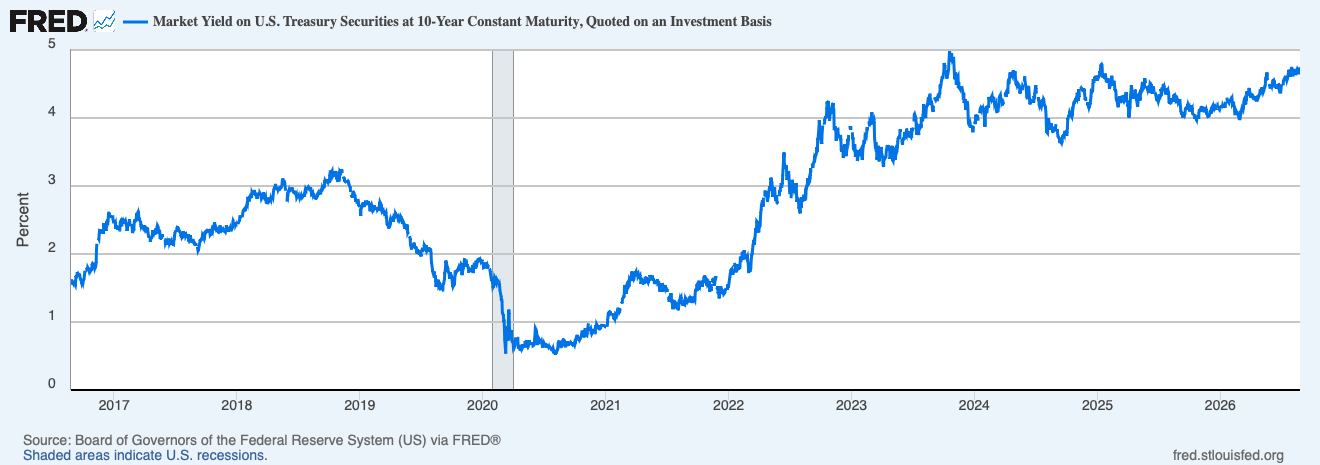
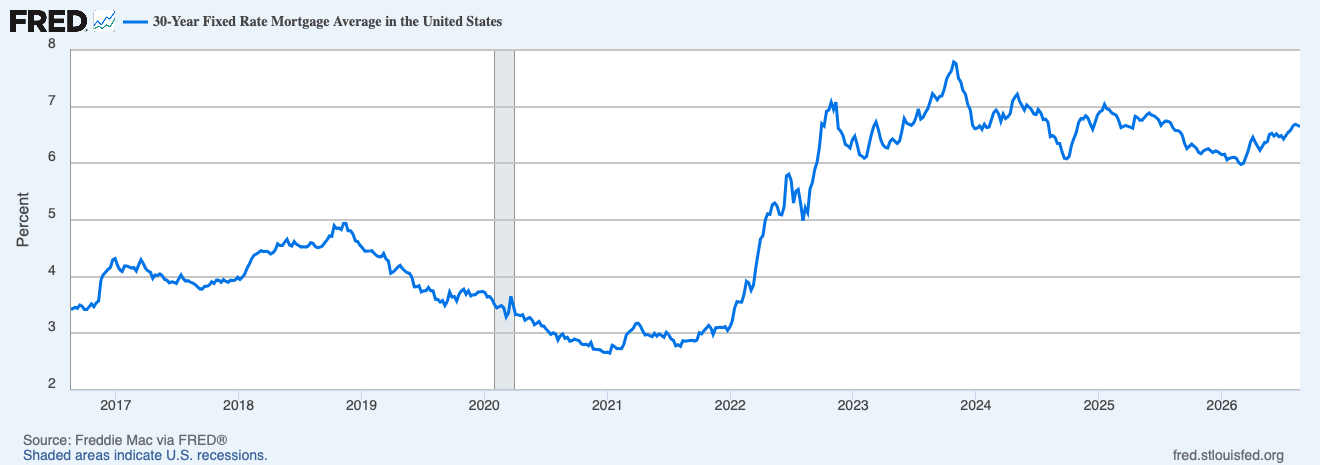
Our national debt’s effects are already shaping everyday life in ways that most Americans barely notice, but will become increasingly visible in the years ahead. To start with, the same 10-year Treasury Bond interest rate I discussed above is effectively used as the “risk-free” rate. This means that banks and other financial institutions use Treasury rates as the starting point for loans to private citizens and businesses, then charge a premium based on the assessed risk of both the borrower and the type of loan being made. As our debt situation has worsened, so has the credibility of the American government. As one example, over the past 10 years the 10-year treasury rate increased by 3.1 percentage points. Over that same time, the 30-year mortgage rate rose by a similar 3.2 percentage points. Higher rates in the private sector creates higher borrowing costs for businesses which slows overall economic growth, reduces job creation, and ultimately lowers wages across the nation. The scale of our national debt, and consequently the markets’ faith in our ability to pay it back, has already been having a negative effect on Americans for years.
In the years ahead, these effects will become much harder for Americans to ignore. In 2025 interest payments on our debt accounted for $970 billion, or 14%, of our total federal spending. More concerningly, this was 51% of our discretionary spending. Servicing the debt was a larger line item than every program other than Social Security and Medicare. Yes, this means it was even bigger than our defense budget. Hard to believe, right?
These massive expenses show no sign of slowing. The Congressional Budget Office (CBO) is expecting our interest payments to grow by an additional 7.2% to over $1 trillion in 2026. This will be 3.2x the expected 2.2% GDP growth. Contrary to what some on the left have said, this is not an issue we can grow our way out of, and soon Congress will be forced to choose between raising taxes, cutting programs Americans rely on, or borrowing even more just to keep up with the costs of our previous borrowing.
The Need to Act Now
Our nation is now at a precipice. Our collective bill has reached $40 trillion, or $120,000 per person. Current debt levels, measured as a percentage of GDP, are higher than any point in US history and both parties’ continued inability to meaningfully address the rising deficit is putting the country’s long-term economic stability in peril. Recent Treasury actions and the market’s disbelief in their worth underscore just how precarious our fiscal position has become. The department is resorting to increasingly risky and unprecedented measures to contain the crisis. While these moves may provide short-term stability and a path to sustainable economic management, they could prove disastrous unless Congress pairs them with sound policy that actually attacks the underlying problem.
Senator Risch has had 18 years to address the crisis. He even claimed back in 2008 that “balancing the federal budget is simple.” I would like to ask the Senator: if it is so simple, why has the debt quadrupled under your watch? But since Risch rarely, if ever, holds public events in Idaho, and has thus far refused to debate me, I, like most Idahoans, may never get the chance to ask him anything. I wish I could give you a concrete five-step plan that would immediately solve the issue, but the issue is far more complicated than any quick fix can handle. What I can offer are the principles that should guide us. At its core, our debt is both a revenue problem and a spending problem. On the revenue side we need to close the tax loopholes that allow bad actors to game the system.
There’s an old joke that the American tax code consists of about 30 pages that tell you how to pay your taxes, and thousands of pages that tell you how to avoid paying your taxes. There are three main problems here:
1) Those thousands of pages are only useful to people who can actually afford the accountants and attorneys who know how to read them
2) Lobbyists wrote most of them and the members of Congress who took their money passed them, and
3) That this isn’t actually a joke - it’s a grim reality.
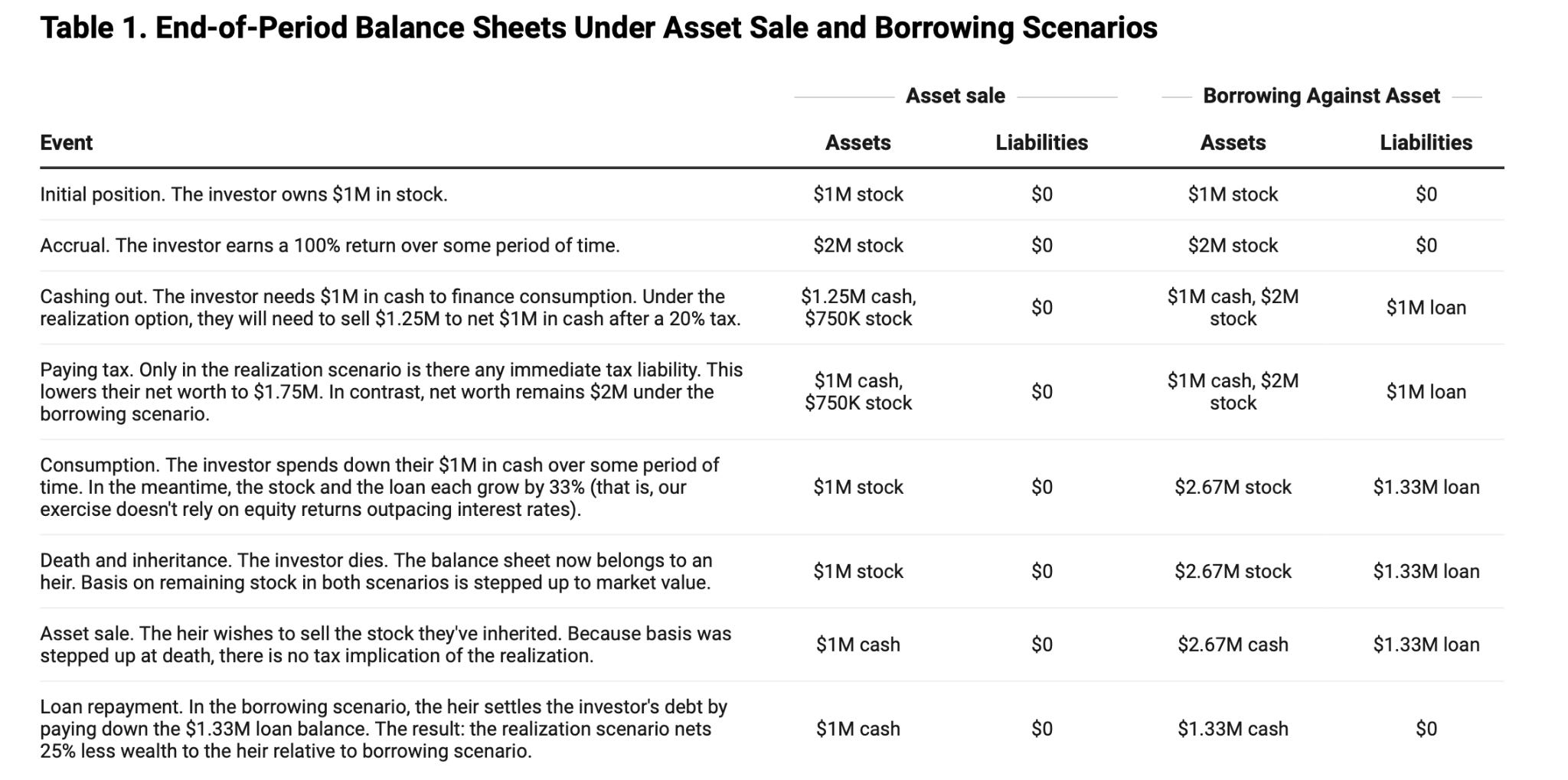
In 2022 I paid more taxes than my former employer T-Mobile. That’s not right. Warren Buffett also famously pointed out that his secretary has a higher yearly bill than he did. Two of the larger loopholes that some very wealthy people exploit is “buy, borrow, die” and carried interest. “Buy, borrow, die” is when an investor buys a stock, covers their expenses with loans using the stock as collateral to avoid selling the stock and paying capital gains taxes on it, and then dies, passing the original stock onto their heirs. In practice this loophole works because rich people can get cash without selling their stocks – thus avoiding any tax. When they die, those stocks pass to their remaining family at their current market value rather than their original purchase price. The gains accumulated during the original owner’s lifetime effectively disappear for tax purposes, and the heirs can sell the stocks to pay off the outstanding loans, again avoiding any tax. It’s a little confusing, just like our tax code but the visual below from Yale’s Budget Lab should help explain it.
A second loophole exploited by the elite is carried interest. Using this loophole, Wall Street partners get to take part of their pay as a percentage of the profits their firm made. But because the law allows them to consider this portion of profits to be capital gains instead of income, and capital gains taxes are much, much lower than income taxes, they get a large portion of their income and pay far less in the way of taxes. Also, not for nothing - because this carried interest isn’t considered income, it is not subject to Social Security taxes. This therefore contributes to the main reason why Social Security is running out of money - it’s paying for all of America’s retirement while using a much smaller share of Americans’ income to do so.
Social Security worked when everyone’s income was taxed as income. Fortunately, my Social Security policy would close this loophole by equalizing tax rates between capital gains and income. All income would be taxed like income, and fairness would be restored. But even if I can’t get my Social Security fix through Congress - I will still work to close this loophole, and others like it. Something is fundamentally wrong with a system that asks working Americans to carry a heavier burden while ensuring that those with the greatest resources have the greatest ability to avoid it.
The same principles apply to expenses. We cannot talk seriously about fiscal responsibility while taxpayers subsidize some of the largest and most profitable corporations in the world. Why should Walmart employees have to rely on Medicaid instead of receiving adequate health coverage from their employer? Why the government of the people, by the people, and for the people provide Amazon with 15.2 billion dollars in subsidies? Capitalism requires a fair playing field for all participants. The government should not stack the deck for those already winning, much less at the expense of our nation’s financial stability.
Fixing our nation’s financial planning is a hard task and will require serious people from all sides to sit together to make the difficult decisions needed to put our country back on solid ground.
Jim Risch has proven that he is not one of those people.
I’m running because I am.
This is not an abstract policy goal but rather a necessary requirement for responsible governance. A government that cannot control its debt, scrutinize its spending, or plan beyond the next election cannot meet the needs of the people it was elected to serve. It is not just a system that is incapable of succeeding. It is a system destined to fail. Idaho cannot afford to keep Jim Risch in office any longer.
Closing Note
We have all grown up in a world of financial stability. In the world formed by the economic and international system America created after WWII. The lives we have known are founded on free, safe, low-insurance premium navigation of the seas, on the bet-your-life-savings-and-sleep-easy safety of US government debt. On the primacy of the dollar as the world’s reserve currency. All of that is now in danger including the ability of our nation to recover after a national crisis like 9/11. It may disappear not just in our lifetimes, but in the next few years. If it does, we have no way of knowing what will take its place. But whatever comes next is going to likely be very different, chaotic, and it will leave our country much poorer, less economically stable, and far more vulnerable.
Whether it is aiding and abetting reckless spending, ignoring the problem, or always answering to partisan demands, Jim Risch has spent his career claiming to be a conservative, and his last 18 years proving that he is anything but.
Paid for by Todd Achilles for Idaho / J. Patrick Riceci, Treasurer. Copyright (C) 2026 Achilles for Idaho. All rights reserved.
Some of our national problems, like the immense debt, seem insurmountable. The main reason is that our federal government with all the partisan finger pointing and dark money has become nonfunctional. Mr. Achilles is a policy nerd with solutions to the big problems. If we can elect him and other independents they can lead passage of new laws to fix those problems.
Wow! Knowledgeable, articulate, and unafraid of tackling tough issues !